Monday, 26 March 2012

Special Frontier Force

The Special Frontier Force (SFF) is a paramilitary unit of India. It was conceived in the post Sino-Indian war period as a guerrilla force composed mainly of Tibetan refugees whose main goal was to conduct covert operations behind Chinese lines in case of another war between the People's Republic of China and India.
Based in Chakrata, Uttarakhand, SFF is also known as the Establishment 22.The force was put under the direct supervision of the Intelligence Bureau, and later, the Research and Analysis Wing, India's external intelligence agency.


Current roles

With warming of Indo-Chinese relations, SFF has moved out of covert operations to various other fields like counter-terrorism. The major functions of SFF in the present day scenario are as follows:

Counter-terrorism

One Squadron is responsible for counter-terrorism duties, with a team in a constant state of alert. The four squadrons rotate through this role on a six-monthly basis. Special Group teams regularly conduct CT operations in troubled Kashmir against militants on specific intelligence inputs.

Special Group

The Director General (DG) Security, Research and Analysis Wing (R&AW) in 1982 dispatched 500 SFF operatives along with over 500 Indian Army special forces to Sarasawa for Counter Terrorist training. It is also thought that the selected troopers thereafter were sent to Israel for highly specialized training. These men formed the nucleus of an ultra-elite and highly classified new detachment, known as the Special Group. It is a volunteer force and persons are inducted only after a very tough probation and selection process.Alone among the 'Vikas regiments' or SFF battalions, it is not made up of tibetans but exclusively recruits Indians volunteering from Indian Army units.
The SFF Special Group's headquarters is supported by an Intelligence and Planning wing, a Training wing and a specialist Signals Troop which is solely responsible for support operations. Having four squadrons each made up of around 100 troopers, which are further divided into four troops. Each troop has a specialized role. The Special Group has a wide range of responsibilities, each requiring specific training and disciplines.
Special Group is also the parent unit of elite National Security Guards(NSG). The NSG was raised after SG participated in Operation Bluestar. It was thought that a paramilitary force not under the Ministry of Defence should be used for counter terrorism operations internally. The NSG is thus led by an IPS officer and comes under the Ministry of Home Affairs, even thought the commandos who lead operations are themselves from the army. After the formation of NSG Special Group is no longer involved in hostage rescue and counter terrorism.

Intelligence Gathering

Long Range Reconnaissance Patrols or Pathfinders must be able to remain hidden under the nose of the enemy for days or weeks on an end. The outfit was trained to do this against the Chinese but actually used the technique to great success in Pakistan-administered Kashmir and the fields of the northern state of Punjab.

Combat Air Control

With the emphasis on air power in modern warfare there comes a need for skilled combat air controllers, men on the ground calling in air strikes. There is usually a trooper specially trained to guide in attack aircraft for a strike, verbally or using Laser Designators. SFF Special Group troopers effectively demonstrated this capability during India's Kargil conflict with Pakistan in the summer of 1999.

Close Protection

The Special Group, along with the Special Protection Group (SPG) were the pioneers at close protection (CP) duties in India, having developed many of the protocols themselves, unique to the Indian subcontinent. Nowadays much of the VIP protection is the sole responsibility of the National Security Guards (NSG) and other specialized provincial units.

Training Foreign Military

Over the years, the Special Group has shared their expertise with a few friendly nations like Maldives and Nepal, training their own special forces. The government also gets political benefits from such arrangements

Promotion System

In the recent years,the promotion System of the Indian Army has come to acid test.As per the promotion system,a person in the Army is evaluated by:-
  • ACRs(Annual Confidential Reports)-This is a quantitative evaluation of officers measuring upto about 17 different criteria where they are graded on a scale of 1-9.
  • Pen Picture -It includes brief description of traits displayed by the officer as well as recommendations for future promotions.
This is a system that is believed to have been a success in the Indian Army for the recent years.But in today's world,this is spelling disaster for the army as now in regard to people posted in peace areas,it has become an evaluation system of a person's ability to appease his seniors in the best possible way,be giving gifts to organizing parties.Moreover,the people serving in peace areas often tend to have inflated reports as compared to their counterparts in the field areas.Unfortunately the army makes no disparity in reports collected in peace and field area.As a result of this,during the promotion boards,the peace timers tend to overtake the rest and hence deprive this army of capable officers.

An army which is not regularly involved in active warfare tends to undergo a rusting of its ethos and culture which creates an environment that only spills unprofessional-ism through its ranks.It is disgusting that the promotion policy has come to  'weeding out the best' in the recent years.peace timers have come to be evaluated on theirs 'gardening and golfing skills'.The fact that combat skills and honors of an officer hold very less value only exemplifies this.
Today in the army your promotion is' not on how good you are but to how good you look in front of your seniors'.Peace timers heavily capitalise on this aspect.A bouquet of flowers to the commanding officer's house on b'day of any of his family members can certainly assure you of a 9 grade in your ACR,but doing what an officer should really do is going to fetch you very little appreciation.Gone are the days when being in the infantry was a matter of pride.Today people from there can indulge only in self pity as their experience in varied field area has got little to do with their promotions.In fact,it is even ironical that few people even in the infantry occupying the highest ranks are those who have never served in tough field areas because they were really good at liasoning and were able to put off such posting.This in turn has a vary negative impact on the health of the army as an hardworking officer finds little incentive in for his efforts.

With the 'Shammers'   lurking up in the steep hierarchy of the indian army,it'll be right to say,that in case of a war,India will not only lose brutally with such incapable generals,but will also face high casualty.
How can people who themselves have no war experience guide troops to participating in one.The primary purpose of Armies is to fight and win wars and officers who show promise in the battlefield must be identified, and nurtured from as early as possible. Soldiers like Field Marshal Sam Manekshaw, Gen Timmy Thimayya, Lt Gen Bhagat and Lt Gen JFR Jacob had fought battles and suffered wounds as young officers.That is why they proved to be such good senior commanders and did well as war leaders. Officers who are very good at event management/hospitality chores should be permitted to migrate to the hotel Industry. They cannot shirk combat and then demand to be promoted to the highest level on the plea that it is not their fault that they were not given an opportunity to go to the battlefield

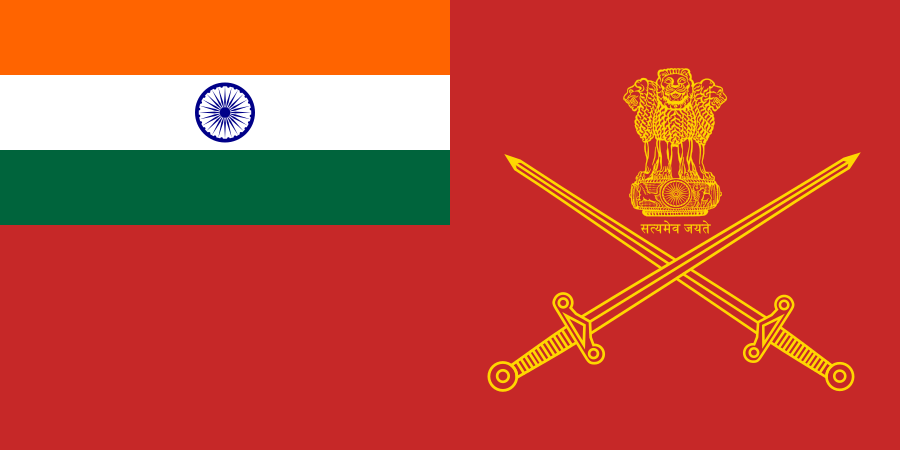
The Indian Army

The Indian Army (IA, Devanāgarī: भारतीय थलसेना, Bhāratīyan Thalasēnā) is the land based branch and the largest component of the Indian Armed Forces.
According to the IISS, in 2010 the army had a strength of 1,129,900 active personnel and 960,000 reserve personnel,making the Indian Army the world's largest standing volunteer army.
Its primary mission is to ensure the national security and defence of the Republic of India from external aggression and threats, and maintaining peace and security within its borders. It also conducts humanitarian rescue operations during natural calamities and other disturbances. The President of India is the Commander-in-Chief of the Army. The Chief of Army Staff (COAS), a General, is a four star commander and commands the army. There is typically never more than one serving general at any given time in the Army. Two officers have been conferred the rank of field marshal, a 5-star rank and the officer serves as the ceremonial chief.
The Indian Army came into being when India gained independence in 1947, and inherited most of the infrastructure of the British Indian Army that were located in post-partition India. The Indian Army is a voluntary service and although a provision for military conscription exists in the Indian constitution, it has never been imposed. Since independence, the army has been involved in four wars with neighboring Pakistan and one with the People's Republic of China. Other major operations undertaken by the army include Operation Vijay, Operation Meghdoot and Operation Cactus. Apart from conflicts, the army has also been an active participant in United Nations peacekeeping missions.